Hazardous Tree Removal Lilburn GA
Some trees are too dangerous for a standard removal approach. Hollow trunks, severe leans toward structures, entangled power lines, decayed root systems � these high-risk situations demand specialized equipment and experienced operators. That is exactly what our hazardous tree removal crew delivers across Lilburn GA 30047.
Specialized Hazardous Tree Removal in Lilburn GA 30047
A hazardous tree is not the same as an unwanted tree. It is a tree that presents an active risk of failure � one that could fall on your home, drop a massive limb onto your car, or topple into power lines at any moment. These trees require a different level of planning, equipment, and expertise than routine removals.
Our hazardous tree removal service handles the jobs that other tree companies turn down. We bring cranes, specialized rigging systems, and operators with years of experience working in high-risk environments. Every hazardous removal starts with a thorough assessment that identifies the specific failure risks and determines the safest approach for your property.
In Lilburn 30047, hazardous trees are more common than most homeowners realize. Gwinnett County's weather � severe thunderstorms, occasional tornadoes, winter ice storms � weakens trees progressively. A tree that has weathered a dozen storms may be one more wind event away from catastrophic failure. Root decay from Georgia's wet clay soils compounds the problem, often undermining what looks like a perfectly healthy tree above ground.
What Makes a Tree Hazardous
Not every dead or leaning tree qualifies as hazardous. A tree becomes hazardous when it has both a high likelihood of failure and a target in its fall zone � your home, your car, your fence, a walkway, a power line, or an area where people spend time. We evaluate both factors during our assessment:
- ? Hollow or Decayed Trunks � Internal rot reduces load-bearing capacity, often invisible from the outside
- ? Severe Lean Toward Structures � Progressive leaning indicates root failure or soil instability
- ? Split Trunks with Included Bark � Co-dominant stems with bark inclusion are structurally weak
- ? Root Plate Failure � Soil heaving, visible root lifting, or construction damage to major roots
- ? Dead Crown Over High-Traffic Areas � Dead branches directly above driveways, decks, and play areas
- ? Trees in Contact with Power Lines � Any tree touching or within striking distance of utility lines
Our Approach to High-Risk Removals
Hazardous removals require more planning and more equipment than standard tree work. Here is how we approach these complex jobs:
First, we conduct a detailed risk assessment. We evaluate the tree's structural integrity, lean direction, weight distribution, and the location of all potential targets. We check for underground utilities and overhead wires. We measure distances and identify the safest rigging points.
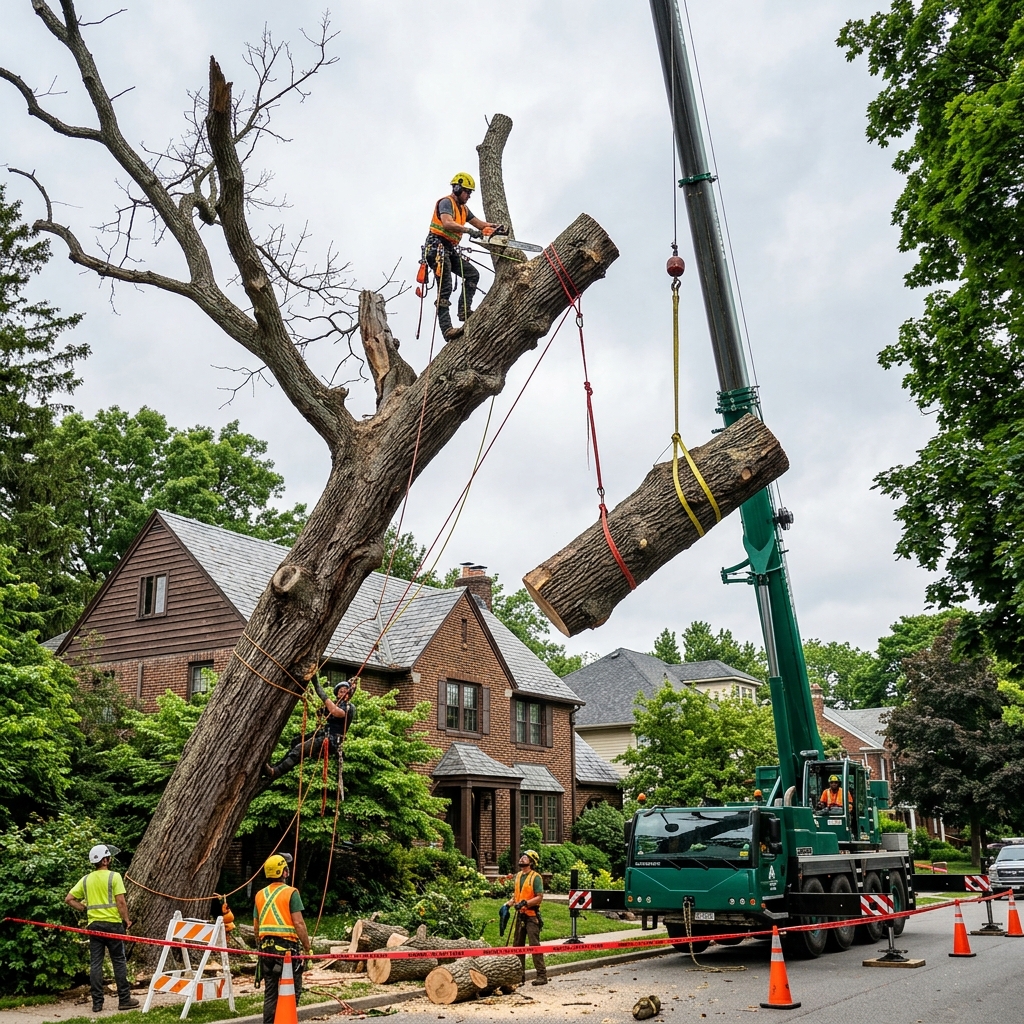
For trees leaning toward homes in tight spaces � common throughout older Lilburn neighborhoods near Arcado Road and Old Town � we use crane-assisted removal. The crane lifts each section vertically away from the structure, eliminating the risk of lateral swing into your home. For trees tangled in power lines, we coordinate with Georgia Power to de-energize the line before beginning work.
Every hazardous removal includes a safety exclusion zone around the work area, emergency response planning, and constant communication between the ground crew, climber, and crane operator. Nothing is left to chance.
Why We Handle Hazardous Removals Others Won't
Crane-Assisted Removal
Hydraulic cranes lift sections vertically over homes and structures
Advanced Rigging Systems
Controlled lowering prevents damage to property below
Experienced Operators
Crew trained specifically in high-risk tree operations
Full Documentation
Risk assessments and reports for insurance and legal records
Signs You Have a Hazardous Tree
If you notice any of these conditions on a tree near your home, call for a professional assessment before the situation worsens.
Mushrooms at the Base
Fungal fruiting bodies growing near the trunk base or along major roots indicate advanced internal decay. The tree may look fine above ground while being structurally compromised below the surface. This is one of the most dangerous conditions because it is so deceptive.
Trunk Cracks or Cavities
Vertical cracks in the trunk, open cavities from old wounds, or seams where bark has pulled apart all indicate reduced structural capacity. Under heavy wind load or ice accumulation, these weak points become failure points.
Soil Heaving at the Root Flare
Raised or cracked soil around the base of a tree indicates that the root plate is pulling loose from the ground. This is a precursor to the tree uprooting entirely � often triggered suddenly during wind or rain events.
New or Increasing Lean
A tree that has developed a lean it did not have before � or a lean that is getting worse � signals active root failure. Unlike trees that have always grown at an angle, a new lean is a clear warning of imminent risk.
Hazardous Tree Removal FAQs
A hazardous tree has structural defects that cannot be corrected by trimming � hollow trunks, severe root decay, split stems, or progressive leaning. If trimming can address the issue (like removing deadwood or reducing weight), we will recommend that instead. Our assessment distinguishes between trees that can be saved and trees that need to come down.
Typically yes, because hazardous removals require specialized equipment (cranes, advanced rigging), more crew members, extensive planning, and additional safety protocols. The extra cost reflects the additional complexity and risk management involved. We provide exact pricing during our free on-site assessment.
Some homeowners policies cover hazardous tree removal when the tree poses an imminent threat to an insured structure. We provide professional risk assessment reports that clearly document the hazard � this documentation often supports insurance approval. Check with your carrier for specifics on your policy.
We strongly advise against waiting with hazardous trees. The conditions that make a tree hazardous � decay, root failure, structural cracks � only worsen with time. A tree that is borderline today may fail catastrophically during the next storm. Early removal is safer, often less expensive, and prevents potential damage to your property.
Concerned About a Hazardous Tree
Do not wait for the next storm. Call for a free hazardous tree assessment from our specialized removal crew.
(470) 260-1968